- Tradition
- Psychological readingPeople dreams
- Draws on
- Domhoff, Cartwright, Hartmann
- Reviewed
- 6 min read
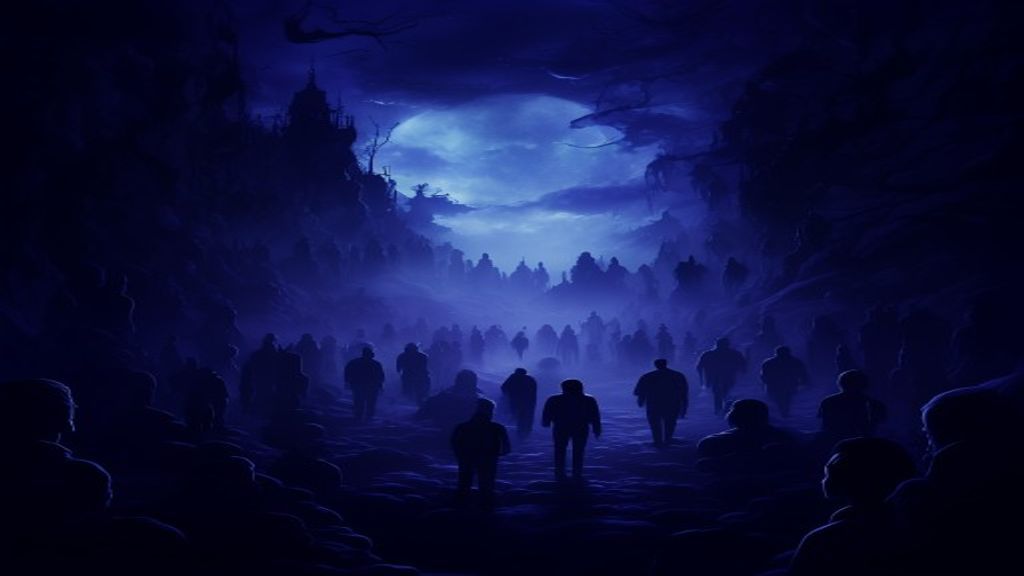
Is being surrounded by people in a dream a good sign or a bad one? Usually it is a report on how you are handling connection and demand, and the honest answer turns on one detail: whether the crowd felt like pressure or like warmth. A crowd that presses and a crowd that holds can be the same room, with the same faces and the same noise. The difference is what you carry out of the dream, and that residue tells you more than the image does.
The version that gets under the skin isn’t the festival crowd or the stadium full of cheering strangers. It’s the intimate crowd: the party at someone’s house where you know most faces but not all, where you can’t quite get a full breath, where the noise is friendly but total. That particular flavour of surrounded is worth taking seriously.
Being surrounded by people in a dream usually reflects how you’re navigating connection and demand in waking life. A crowd that feels warm points toward belonging or longing for it. A crowd that feels pressing or inescapable often mirrors social overwhelm, obligation, or an inner life that’s had very little quiet lately.
The noise that follows you out of sleep
What I find interesting isn’t the crowd itself but what it sounds like when you wake. Sometimes a kind of warmth is still clinging to you. Sometimes you shake the dream off the way you’d shake off a stuffy room. The two responses tell completely different stories, and I’d almost argue the dream image matters less than the residue.
G. William Domhoff’s work on the continuity hypothesis keeps nudging me back to this point: our dreams don’t invent our social world from scratch, they rehearse and extend it. If your waking life is full of people who need things from you, the crowd dream shows up densely, chaotically, full of half-finished conversations. If your waking life is quieter than you’d like, the crowd is golden and slightly out of reach. The dream knows which flavour you’re living.
Whose faces were in the crowd
This is where I’d start. Not “how many people” but “did you recognize them?” Because strangers and familiar faces behave very differently in this symbol.
A crowd of people you know, or mostly know, tends to pull meaning from your actual social network: the relationships that are active, demanding, or quietly unresolved. A crowd of strangers is more atmospheric, more about your sense of being among people in general rather than these particular people. And the hybrid crowd, where you recognize everyone but somehow can’t reach any of them, that one is its own category. It’s the one that wakes you feeling lonelier than if you’d been alone.
If you were dreaming of people from a specific context, a work crowd or a childhood crowd, that context is probably the subject of the dream more than the crowd itself. Your mind isn’t just showing you people. It’s showing you a chapter of your life, populated.
Warm, familiar crowd dreams often trace feelings of belonging, gratitude, or the quiet fear of losing people you’ve built a life around. The mood tells you which one is doing the work.
A faceless or anonymous crowd tends to be less about specific relationships and more about your experience of the social world in general. Feeling buoyed by it or drowned by it is the whole message.
When the crowd includes people who’ve died or drifted away, the dream is almost always about grief and continuity. The mind is still counting them among your people, even now.
The half-known crowd often mirrors social exhaustion: too many connections pulling in too many directions. You can’t quite name anyone because no one connection is fully present to you.
When the crowd is the problem
Rosalind Cartwright’s work on dreaming and mood regulation, which she studied in people going through divorce, gives a useful frame: dreams work on emotional weight rather than merely replaying it. If you’ve spent three weeks being needed by everyone, the surrounded dream isn’t a surprise. It’s almost a transcript. When the crowd is a place that costs you something, dreaming of a market is the same press of bodies with a price attached.
Ernest Hartmann would add that the emotional tone of the crowd, pressed, warm, chaotic, adoring, functions like a central image: a way the dreaming mind wraps a feeling in a shape big enough to hold it. Which means the interpretation isn’t really about crowds at all. It’s about the specific texture of social life you’ve been living.
So if the crowd felt like a wall you couldn’t get through, that’s not necessarily social anxiety in the clinical sense. It might just be accurate. You might genuinely be surrounded by demands right now, in a way that doesn’t leave much room to think.
The same crowd, a different report
Take the same kitchen, the same half-known faces, the same noise. In one dream it feels like a trap. In another, a few nights later, you’ve found a quiet corner and someone you actually love is standing in it. You wake up warm. Same image, totally different report.
I think that’s the thing about being surrounded by people in dreams that the quick interpretation misses: it’s not one symbol. It’s the crowd as longing, or the crowd as pressure, or the crowd as comfort, or the crowd as the last thing between you and something you’re trying to reach. You probably know which version you had. If one face in the crowd belonged to someone you’re in conflict with, dreaming of an enemy reads that figure as unfinished business, which changes what the rest of the crowd is doing.
There’s also the question of what you were doing in the crowd. Moving through it? Frozen in it? Looking for someone? Being looked for? Searching for one specific person within a crowd, and never finding them, is often the dream doing the emotional work of trying to locate something that has already changed in your waking life.
And sometimes the crowd is just affection, loud and unambiguous. Some people dream of being surrounded and wake up grinning. The people they love are alive and present and making noise. That’s not a symbol to decode. That’s the mind doing something kind. If you woke up happy, I’d let the interpretation rest and take the feeling at face value. When the crowd has gathered specifically for you, dreaming of a birthday party asks what your mind is counting.
Same room, same crowd. One felt like a trap. One felt like a gift. The dream hadn’t changed. The dreamer had found the corner.
- Did I recognize the people around me, and which ones couldn’t I quite reach?
- Was the feeling pressure, warmth, longing, or something else underneath the noise?
- Was I looking for someone specific, or just trying to get somewhere?
- What does my actual social life feel like right now, and does the dream match it?
Quick answers
What does it mean to dream of being surrounded by people?
It usually reflects your emotional relationship with connection and social demand. A warm crowd often means you’re longing for or grateful for closeness. A crowd that feels pressing or inescapable tends to mirror real overwhelm: too many people needing something from you, and not enough room left for quiet.
Is dreaming of a crowd a good or bad sign?
Neither on its own. The feeling is everything. The same image, a room full of people, can mean longing, belonging, suffocation, or celebration depending on what it felt like from the inside. Trust your emotional memory of it more than the image itself.
Why do I dream of being surrounded by strangers?
A crowd of strangers is less about specific people and more about your experience of the social world in general. It might mean you’re navigating unfamiliar territory, feeling anonymous, or craving the kind of connection that’s present but still undeveloped in your waking life.
What does it mean if I can’t reach anyone in the crowd?
That’s one of the lonelier versions of this dream. Being surrounded but unable to connect with any one person often points to a feeling of isolation inside a busy life: plenty of people, not enough genuine contact. It’s the crowd as distance, not closeness.
Sources for this reading
- Domhoff, G. W. (2003). The Scientific Study of Dreams: Neural Networks, Cognitive Development, and Content Analysis. American Psychological Association.
- Domhoff, G. W. (1996). Finding Meaning in Dreams: A Quantitative Approach. Plenum Press.
- Cartwright, R. D. (2010). The Twenty-four Hour Mind: The Role of Sleep and Dreaming in Our Emotional Lives. Oxford University Press.
- Hartmann, E. (1998). Dreams and Nightmares: The New Theory on the Origin and Meaning of Dreams. Plenum Trade.
Full bibliography on Sources and method. Found a mistake? Tell us and see the corrections log.