- Tradition
- Psychological readingVehicle dreams
- Also read in
- The BibleSame symbol, other tradition
- Draws on
- Domhoff, Artemidorus
- Reviewed
- 5 min read
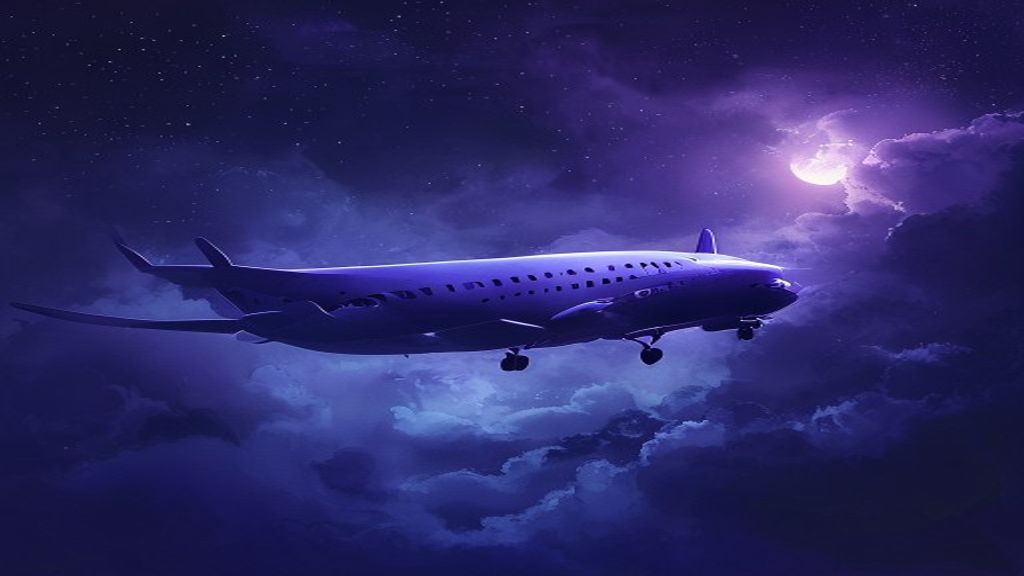
The seat belt is fastened and the plane is going down, and the weird part is that you aren’t scared. The thought that arrives is almost workmanlike: well, this is it. That is the calm of the big flight dream, which compresses everything terrifying into something you can almost sit through.
The versions vary. The plane’s going down, or it won’t lift off, or you’re watching it from the ground, stomach tight, knowing someone you love is on board. Airplanes in dreams are one of those symbols that feel obviously metaphorical even while you’re in them. You don’t need a decoder ring. The altitude is already doing the talking.
An airplane in a dream usually maps to something in your waking life that’s in transit: an ambition taking shape, a plan you’ve handed control of to someone else, or a fear about where you’re headed. The specific version matters a lot. Smooth flight points to trust in the process. Crashes, stalls, and missed departures each carry their own distinct weight.
The announcement you can’t quite hear
Here’s the detail that gives airplane dreams their texture: the gate announcement. You know the one. That slightly-too-loud PA voice in airports that you simultaneously hear and don’t process, the one that might be calling your flight or might be background noise. A lot of airplane dreams live in that exact suspended state. You’re not sure if you’re leaving, if you’ve already left, if you even have a ticket.
That particular uncertainty, the one that makes you pat your pockets in the dream, is doing real psychological work. G. William Domhoff’s continuity hypothesis holds that dreams extend what we’re actually preoccupied with in waking life. An airplane dream full of that queasy not-sure-if-I’m-ready feeling isn’t obscure. It’s your mind playing back a loop it can’t stop running during the day.
One long-standing reading treats flight itself as an image of aspiration reaching too far from the ground, a mind so caught up in possibility that it’s lost contact with the body, with the earth, with what’s real. On that reading the cramped middle seat means something different from the first-class window, and I’d agree. Where you are in the plane matters. Whether you’re piloting or passive matters enormously.
What kind of flight was it
The ascent feels clean, the window fills with sky, and you wake up with something close to relief. This tends to follow a decision that’s finally been made, or a plan that’s actually started moving. The plane doesn’t care about your doubts. It just climbs.
Almost everyone assumes this is a nightmare, but the emotional register varies wildly. Fear means one thing. The eerie calm is something else entirely: a feeling that you’ve accepted what’s out of your hands. Both versions point to a situation where control has left the building. The question is whether you’re terrified or, strangely, okay with that.
It taxis, it accelerates, it does not leave the ground. This is probably the most frustrating version, because the machinery is all there and something still fails to launch. Ambition, plans, projects that keep stalling at the runway. Whatever you’ve been waiting for permission to do.
You’re not on it. Someone else is, or it’s just a shape banking overhead, and you feel the weight of not being aboard. Distance-from-your-own-life dreams. Common when you feel like a spectator in a transition you should be driving.
Gate closes, door sealed, you’re standing there with your boarding pass crumpled in your hand. One of the more visceral missed-opportunity dreams. It tends to show up not around actual travel but around a window you suspect has closed in something that matters more.
Old skies, older readings
Artemidorus, writing in the second century, didn’t have airplanes. He had birds, he had flight by body, he had the sensation of rising in dreams. His principle was that the same dream means different things for different dreamers, depending on age, status and occupation, so rising could mean power or liberation for one dreamer and the opposite for another. What’s interesting isn’t the symbol itself but the interpretive logic: flight dreams have always been read as about where you stand relative to what’s above you. The technology changed. The question didn’t.
The passenger problem
Whether you’re flying the plane or buckled into seat 27C is, honestly, the whole ball game. Piloting and surrendering to someone else’s piloting are almost opposite psychological positions. If you’re in the cockpit: are you confident, are you faking it, is the instrument panel reading things you don’t understand? If you’re in the cabin: do you trust the people up front, or are you gripping the armrest, waiting?
Many airplane dreams are passenger dreams. Which makes sense. Most of what we’re actually living is passenger dreams. The flight was booked, the plan is in motion, and we’re somewhere over the Atlantic wondering if we should have said something at the gate.
If this is a recurring dream, the version that keeps landing in your sleep might be worth following into the waking day. What’s moving that you didn’t choose? What’s stalled that you thought should be flying by now? If it was the loss of motion that stung, the dream of a stolen car is what it feels like when your momentum is yanked away without warning. And the bicycle dream, at the other end of the scale, is the version where you’re generating every bit of forward motion yourself.
Back to the calm in the falling plane. Going down, perfectly composed, and the thought isn’t terror but: well, this is it. That can arrive right after a decision that can’t be taken back, a signed offer, a closed door. That’s not a nightmare. That’s a very honest mind doing its accounting.
It’s tempting to wonder whether the people who dream of smooth takeoffs are braver, or just less honest with themselves. Probably neither. Probably the dream just finds whatever register fits the actual situation. And sometimes the situation is genuinely, quietly, terrifying, and the mind holds your hand through it the only way it knows how: by putting you on the plane and letting you feel it.
- Were you the pilot or the passenger, and which one did you want to be?
- What’s the thing in your waking life that’s currently in motion, and did you choose to board?
- If the plane crashed or stalled, what’s the situation you’ve been bracing for?
- Did you miss the flight, and if so, do you feel relieved or devastated?
One symbol, two traditions
The two schools are not reading the same book: psychology asks what airplane is doing in your waking life, while the biblical tradition tests the image against Scripture and leaves the meaning with God.
An airplane in a dream usually maps to something in your waking life that’s in transit: an ambition taking shape, a plan you’ve handed control of to someone else, or a fear about where you’re headed. The specific version matters…
You are reading this oneThat reading has genuine application. The eagle-wings imagery in Isaiah 40:31 is attached to renewal and purpose, not to ego or ambition alone. If an airplane in your dream represents something you’ve been working toward, the…
Read the biblical meaning →Quick answers
What does dreaming of an airplane mean?
It usually maps to something in transit in your waking life: an ambition launching, a plan underway, or anxiety about a situation you’ve handed control of to someone else. The exact version of the dream, smooth flight, crash, missed departure, tells you whether your mind reads the situation as going well, overwhelming, or slipping past.
Is dreaming of a plane crash a bad omen?
No. Plane-crash dreams are more often about accepting loss of control than predicting disaster. The emotional tone is the real signal: if you wake terrified, you’re bracing for something. If you wake strangely calm, as many people do, the dream may actually be your mind making peace with something you can’t steer.
What does it mean to miss a flight in a dream?
Missed flights tend to appear when you sense a window closing in your waking life, not necessarily a literal trip but an opportunity, a relationship, a version of yourself you could have become. The boarding-pass-in-hand, gate-already-closed image is your mind being precise about the timing.
What does it mean to pilot the plane in a dream?
Being in the cockpit places the responsibility squarely on you, which is the point. If you feel confident, you’re probably owning something in your life well. If you’re faking competence at the controls, the dream is asking you to look at wherever you’re performing authority you don’t feel you actually have.
Sources for this reading
- Domhoff, G. W. (2003). The Scientific Study of Dreams: Neural Networks, Cognitive Development, and Content Analysis. American Psychological Association.
- Domhoff, G. W. (1996). Finding Meaning in Dreams: A Quantitative Approach. Plenum Press.
- Artemidorus of Daldis (2nd century CE). Oneirocritica. English edition: Harris-McCoy, D. E. (2012). Artemidorus’ Oneirocritica: Text, Translation, and Commentary. Oxford University Press.
Full bibliography on Sources and method. Found a mistake? Tell us and see the corrections log.