Food Dreams
Dreaming of a Tomato: ripe, split, or still on the vine
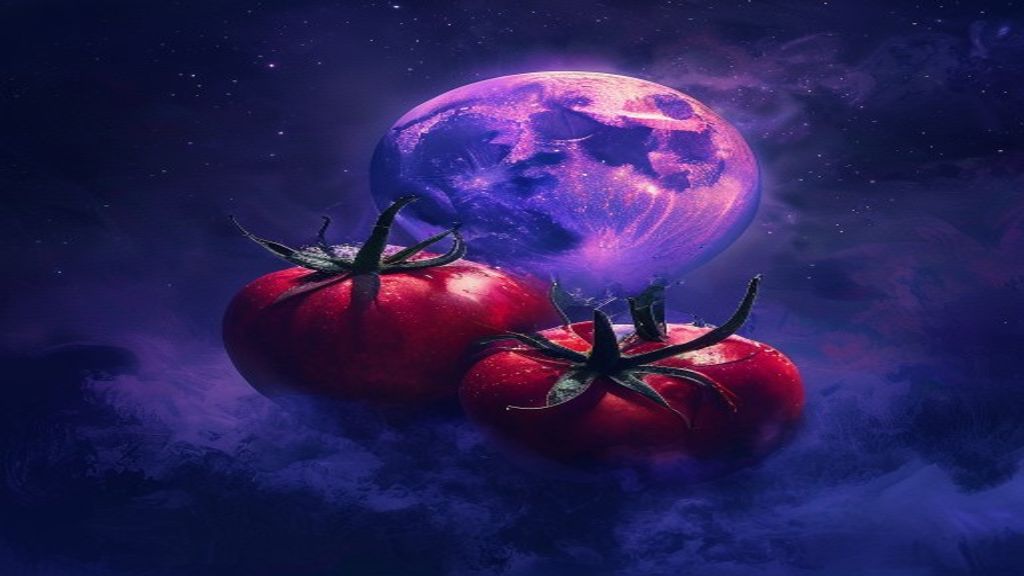
A tomato on a white plate, perfectly ripe, stem still attached. That’s the image. Hold it. Notice what your chest does with it, because that involuntary small response, warmth or faint unease or nothing at all, is probably closer to the dream’s message than anything I can tell you about symbolism.
My kitchen windowsill had three tomatoes on it for most of one October. I’d bought them too early in the week and kept meaning to use them. By Friday one had split along the side, a clean wet crack, red seeping into itself. I kept it there two more days, for reasons I still can’t entirely explain. It wasn’t rotting, exactly. It was just done. Past the point of waiting.
When people describe dreaming of a tomato, it almost always comes with a felt quality like that. Too ripe, just right, split open, still green and hard. The tomato isn’t neutral. It’s one of those dream objects that wears its condition visibly and insists you look.
A tomato in a dream often signals something in your life at a critical point of ripeness: a decision, a relationship, a project that’s either ready to be acted on or about to tip past its moment. The color and condition carry almost all the meaning.
The redness of the thing
Most food dreams don’t arrive in color this specific. A dream potato is brown-beige. A dream apple is shape more than hue. But a tomato in a dream is almost always red in a way the dreamer notices and mentions first. That vividness matters. Hobson’s activation-synthesis model would say the brain’s visual cortex is just doing what it does with a memorable object. Probably. But the brain chose this object, out of everything in its archive, and dressed it in that particular red.
Red in dreams carries urgency whether we want it to or not. It’s not always alarm. Sometimes it’s just aliveness, the color of something that’s fully itself. A perfectly ripe tomato is the exact red of something at peak potential. Which is why the split version hits differently.
Ripe, split, or still green: which one was yours
What Artemidorus would have said
Artemidorus didn’t catalogue tomatoes, which didn’t arrive in Mediterranean Europe until long after his second-century writing. But his method applies: he asked the dreamer’s relationship to the food. Is it something you enjoy? Something associated with abundance in your household? A food linked to celebration, or to scarcity? The same object means different things to different dreamers, and Artemidorus was almost irritatingly sensible about this.
For someone who grew up with a garden, a tomato dream is probably about patience and harvest and things grown slowly at home. For someone who doesn’t cook, it might mean something else entirely, maybe simply the sudden presence of something vivid and perishable in an otherwise abstract life. Neither reading is wrong. They’re just different questions.
The vine and what’s still connected
Domhoff’s continuity hypothesis would suggest the tomato dream maps pretty cleanly to something happening in your waking life right now. Not a past situation and not a future fantasy, but something present and slightly unresolved. Something at a stage where the outcome isn’t fixed yet.
Dreams about dreaming of ice cream tend to carry nostalgia or pleasure-postponed. Dreams about dreaming of beer often surface around social ease or its absence. The tomato sits in different territory. It’s not about pleasure or comfort. It’s about timing. About whether you’re looking at the thing at the right moment.
My October tomato that split on the sill: I kept it past the moment it was food and into the moment it was something else, a small lesson in the gap between ‘not yet’ and ‘too late’ that I apparently needed repeated in different forms. I don’t know that the dream version teaches you any better than the real one. I just know the brain uses whatever’s available.
When the dream makes you uneasy
Occasionally the tomato dream feels wrong in a way the dreamer struggles to name. The tomato is fine, but something’s off. This is the version that makes more sense once you ask where you were in the dream and what you were supposed to do with the tomato. Being handed one without knowing what to do with it is different from picking one yourself. Being told to eat it when you don’t want to is different again.
The tomato as an obligation. The tomato as a judgment. The tomato you had to pretend was fine when it wasn’t. Those versions aren’t really about ripeness at all. They’re about being put in a position where you’re expected to say something is good when you’re not sure it is.
- What was the condition of the tomato, and does that condition match how something in my life feels right now?
- Was I acting on the tomato or just observing it? That distinction changes what the dream is asking.
- Is there something in my life that’s at a point of ripeness I keep deferring to deal with?
- Did the redness feel vivid and alive, or was it the redness of something past its moment?
Quick answers
What does dreaming of a tomato mean?
It usually points to something in your life that’s at a critical state of readiness: a decision, a relationship, or a project. The condition of the tomato, ripe, split, green, or rotten, tells you where that situation is in its arc.
Is dreaming of a tomato a good omen?
If the tomato is ripe and you’re enjoying it, yes. It tends to signal that something is at its right moment. If it’s split or rotting, the dream is more likely flagging that a window is closing or has already closed.
What does it mean to eat a tomato in a dream?
Eating a ripe tomato in a dream usually means taking something in that’s ready for you, an opportunity, a decision, a relationship that’s at its peak moment. Eating one that tastes wrong or feels forced has different implications.
Why did I dream of tomatoes growing on a vine?
A vine dream tends to signal something still in process, still connected to its source, not yet ready to stand on its own. You’re probably in a cultivating or waiting phase rather than a harvest phase, and the dream is acknowledging that.