- Tradition
- Psychological readingVehicle dreams
- Draws on
- Domhoff, Jung, Artemidorus
- Reviewed
- 5 min read
Why is a subway dream so rarely about the train? Most often it is about a path you are on that you didn’t entirely choose: a career track, a social role, a direction that has become automatic. The details people remember are physical, the groan of the doors, the lurch forward, the window turning black between stops, but the question underneath is simple. Did you agree to this line, and do you still want to be on it?
Subway dreams are among the more unsettling transit dreams because nothing in them is scenic. You’re underground. You’re moving at speed you can’t feel. Other people are inches away. Whatever the dream is carrying, it delivers it in close quarters.
A subway in a dream usually points to a path you’re on that you didn’t entirely choose: a career track, a social role, a life direction that feels automatic. The direction of travel (toward something or away?), the other passengers, and how you feel about being underground all shape the reading far more than the train itself.
The smell of warm metal
The anchor here is that smell, the mix of warm metal and stale air that hits you at the top of the escalator before you’ve committed to going down. It’s the part of the subway dream that no one talks about and that everyone knows. Most transit dreams are about movement. The subway dream is often, quietly, about confinement. You entered a tunnel. You handed over your sense of direction. The city above you became theoretical. There’s a particular kind of working life that feels like this, where you board a track that’s already been laid and you go where it goes, and it’s efficient, and it’s not your choice, and both those things are true simultaneously.
In the version that follows you into Tuesday morning, you’re never late. The anxiety isn’t about missing the train. It’s subtler. It’s the recognition, somewhere mid-dream, that you have no particular reason to be on this line anymore, and you’re on it anyway.
What the train is carrying
You’re moving, but you suspect you’ve boarded the wrong line. This tends to surface in transitions: a career shift that hasn’t happened yet, a relationship whose direction has quietly changed. The destination isn’t wrong exactly. It’s just not yours.
The train moves past where you needed to exit and you can’t get off. Almost everyone has this one. It usually means a decision point passed, or feels like it passed, without you acting. Dreams of train accidents sometimes follow this one when the frustration goes deeper.
Pressed in, no room to move, surrounded by strangers who aren’t threatening but won’t make space. This is social pressure dreaming in transit. The crowd is whatever’s crowding you.
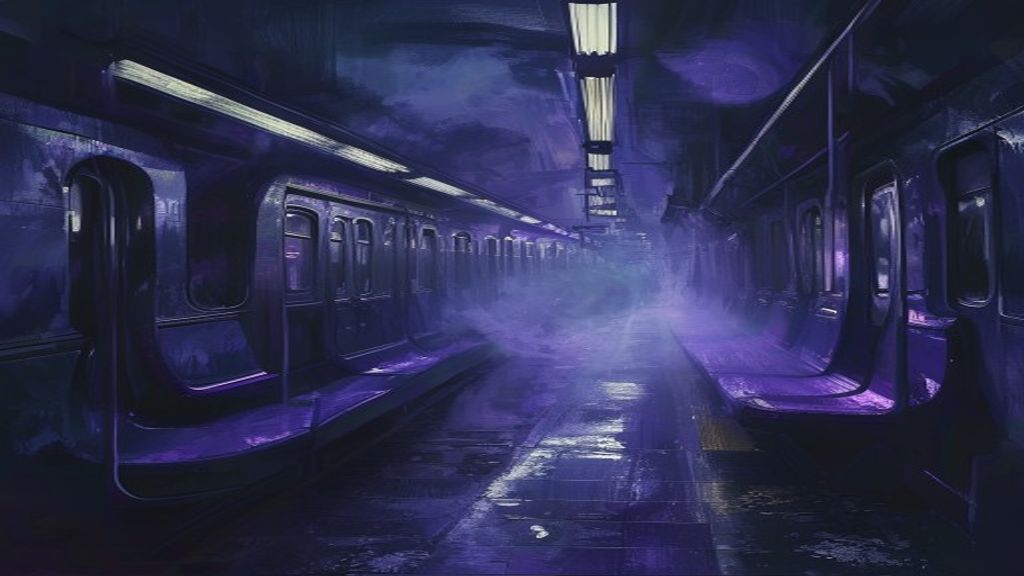
You arrived, but the train didn’t. Or you got off and the station is vast and silent. Loss, or a plan that didn’t materialize. Sometimes just loneliness in a large, humming city.
The tunnel keeps going. Lights flicker or disappear. No announced station. This is the anxious variant, and it tends to cluster around periods of genuine uncertainty about where things are heading.
G. William Domhoff has argued for decades that dream content maps onto what’s actually live in our daily lives, not hidden symbols but extensions of our ongoing concerns. For subway dreams, this is almost uncomfortably legible. You would expect them during career transitions, when a relationship is under strain, or after a move to a city where you haven’t found your footing yet. The subway isn’t metaphor. It’s a location report.
What Jung might say, and what I’d push back on
A Jungian framework treats underground spaces as the unconscious itself. The subway, by this reading, is the self moving through its own depths, which sounds magnificent and is also genuinely hard to argue with. An underground rail system is human ingenuity bent toward the dark; it’s efficient, impersonal, and runs on routes set by people who aren’t you. That does map onto something real about how we experience the parts of ourselves we don’t examine closely. I take this reading seriously. I don’t think it replaces asking simpler questions first.
The simpler question is: where were you going, and did you want to be going there?
An ancient precedent for transit anxiety
Artemidorus, the second-century Greek interpreter of dreams, didn’t have subways obviously. What he did have is a principle that fits them: the same dream means different things for different dreamers, depending on age, status and occupation. A daily commuter’s subway dream and a newcomer’s subway dream are not the same dream. What strikes me is that the principle moves the question from the transport to the dreamer. Whether you were calm or frightened on the train matters as much as the train itself. The same is true underground.
The recurring commute
If the same subway keeps returning, particularly an old commute from a chapter of life you’ve left, the dream is almost certainly pulling on continuity. Not nostalgia. More like the mind checking whether a pattern from that period is still running. You catch yourself thinking, during the dream, that you should ask someone if this line even operates anymore. Nobody in the dream knows. The dream never updates the map. Maybe it doesn’t need to. Dreams of airplane crashes and spaceships take the same question, where is this journey taking me, up to altitude: one when the journey goes wrong, the other when the destination is unknown.
The smell of warm metal at the top of the escalator, still there in the dream, still accurate to a line you may no longer take. What that means is not something you are required to decide on waking.
- Did you know where the train was going, and did you want to be on it?
- Who else was in the car, and did they affect how you felt about the journey?
- Were you moving toward something or leaving something behind?
- Is there a track in your waking life you’re on more by inertia than by choice?
Quick answers
What does it mean to dream of a subway?
A subway in a dream usually points to a path you’re on that operates somewhat automatically, whether a career track, a relationship direction, or a role you’ve grown into without fully deciding to. The mood of the journey matters more than the train’s appearance.
Is dreaming of a subway a bad sign?
Not necessarily. If the journey felt purposeful and you knew your stop, it may simply reflect a period of productive forward motion. The dream tends to worry only when you’re on the wrong line, can’t get off, or the tunnel has no end in sight.
Why do I dream about missing my subway stop?
Missed stops are among the most common transit dreams and usually point to a decision or opportunity that passed, or feels like it’s passing. The anxiety is about timing, not about the subway itself. Worth asking which exit you were aiming for.
What does an empty subway station mean in a dream?
A deserted station tends to suggest isolation or a plan that didn’t come to fruition. You showed up, you were ready, and the system wasn’t running. That can reflect loneliness, disappointment, or simply an idea whose moment hasn’t arrived yet.
Sources for this reading
- Domhoff, G. W. (2003). The Scientific Study of Dreams: Neural Networks, Cognitive Development, and Content Analysis. American Psychological Association.
- Domhoff, G. W. (1996). Finding Meaning in Dreams: A Quantitative Approach. Plenum Press.
- Jung, C. G. (Ed.). (1964). Man and His Symbols. Doubleday.
- Artemidorus of Daldis (2nd century CE). Oneirocritica. English edition: Harris-McCoy, D. E. (2012). Artemidorus’ Oneirocritica: Text, Translation, and Commentary. Oxford University Press.
Full bibliography on Sources and method. Found a mistake? Tell us and see the corrections log.