- Tradition
- Psychological readingAction dreams
- Also read in
- The BibleSame symbol, other tradition
- Draws on
- Domhoff, Cartwright
- Reviewed
- 6 min read
A funeral dream is usually taken as a prediction, or at least as a bad sign. The research points the other way. Domhoff’s continuity hypothesis holds that dreams extend waking concerns, which makes a funeral ceremony a poor forecast and a good report: something in your life has ended, or needs to, and the mind has staged the formality it never got.
Funeral dreams have a particular weight to them. You carry them through breakfast. They sit on the edge of the afternoon. You tend to wake from them either relieved (it wasn’t real) or faintly guilty (why was I dreaming that?). The guilt is interesting. It usually means the dream touched something you weren’t ready to look at directly.
A funeral ceremony in a dream is almost never a prediction. It’s more often a mark the mind places on something that has already ended, or needs to. The ceremony is the dream’s way of saying: this deserves acknowledgment.
The voice in the silence
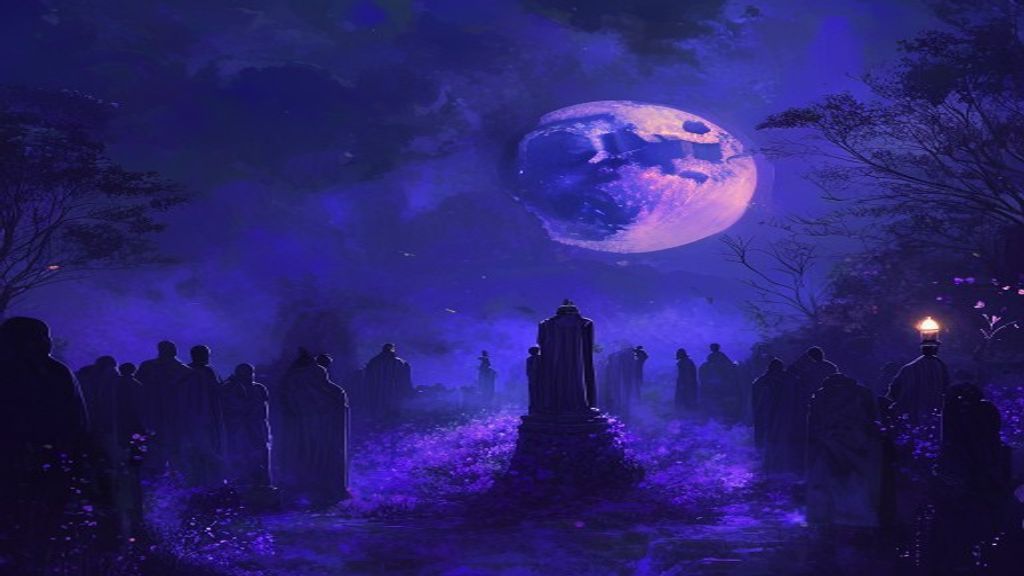
Funerals have a specific sound: one person speaking into a room that’s completely quiet. Everyone holding still. The strange intimacy of a crowd that’s decided, just for a few minutes, to be in the same place with the same thing. That sound tends to be the first thing recalled, or its opposite, a ceremony you can’t quite hear, like watching through glass. Both versions matter.
When you can hear it clearly, the dream tends to carry something through. A real acknowledgment. The ceremony is doing its actual job: marking an end, giving it weight, letting the assembled people say yes, this happened. When you can’t hear it, when the words are muffled or you’re standing too far back, that’s a different signal. Something is ending and you’re not letting yourself be present for it.
The identity of who’s in the casket, or whether there’s a casket at all, matters less than you’d think. What matters is whose funeral it feels like it is. Your own funeral dream is almost never morbid. It’s the most literal form of watching a chapter close. You’re the narrator and the subject at once, and that’s not a horror story. It’s just a particularly honest piece of editing.
What the ceremony itself is doing
Cartwright’s work on dreaming and mood regulation, studied in people going through divorce, suggests the right question for a funeral dream: what are you in the middle of losing, not what are you afraid of? The distinction sounds small. It isn’t. Fear-dreams move fast. Grief-dreams are slow, processional, almost deliberate. A dream that stages a ceremony is doing something different from a dream that ambushes you. It’s organized. It’s treating the end as something worth witnessing.
And the continuity work would add, with characteristic dryness, that the ceremony is almost certainly tracking something real. Funeral dreams cluster around endings: relationships that dissolved quietly, jobs you didn’t realize you’d mourned, phases of life that slipped out without a formal goodbye. The mind, apparently, likes to give things funerals that didn’t get them.
Strange to experience, usually liberating to interpret. This version signals the end of an identity, a role, a version of yourself. It isn’t death-anxiety. It’s self-editing.
Often points to a relationship that has changed or ended in practice, even if the person is still in your life. You’re marking what was. The grief is real even if the subject is alive.
The ceremony is happening but you’re outside it, muffled, distant. Something is ending without your being present for it. The dream is noting the gap.
When you don’t recognize who died, the figure often stands in for a quality, a period, or a feeling you’ve let go of. What have you stopped being lately?
Ceremonies that shift mid-dream into a celebration, a meal, a gathering of people you love. These are the transformation dreams. Something ending is carrying people together.
The part nobody mentions
Some funeral dreams leave you feeling peaceful. Not all of them, but enough that it’s worth saying plainly: the dream isn’t always about grief. A well-run ceremony contains something like relief. It’s done. It was marked. The gathering happened. That feeling can come through in the dream intact, and the peaceful funeral dream is often the sign that something you’d been dragging around has finally been set down.
Cultures have been staging this longer than we have
Dream rituals appear in almost every tradition that kept records. The Chester Beatty papyrus, from about 1200 BC, sorts dreams into good and bad omens, and the Asclepian temples across the Greek world practiced dream incubation, sleeping in the sanctuary to receive a dream from the god. Islamic dream tradition, which draws on Ibn Sirin, treats interpretation as a matter of context and circumstance rather than literal reading.
What’s consistent across this history isn’t the prediction. It’s the ceremony. Traditions with very different theologies have treated dreaming as something that wants a formal response, and the dream-mind seems to want a ritual for the things that ended without one. That instinct might be one of the most human things about dreaming.
A birthday party is the funeral’s mirror image: a gathering that marks time passing, but one that celebrates an arrival rather than mourning an ending. And dreaming of New Year marks the turning of time with a countdown instead of a eulogy.
If someone you loved appears
When the dream is about someone who has actually died, and you’re back at their funeral, or at a new ceremony for them, the experience is its own category. These dreams tend to carry a particular quality of presence, not horror. Often the person is simply there. The ceremony is happening and they’re somehow both the subject and the attendant. It is hard to explain why that feels so real, but it is rarely frightening. More often it feels like being handed something you hadn’t known you needed.
Put it this way: you are already at the funeral. The thing about a funeral dream is that the mind has staged the ceremony, assembled the witnesses, asked for silence. The question the dream leaves you with is whether the waking self is going to show up for it. Not to suffer. To acknowledge. Those aren’t the same thing, and the dream knows the difference.
Many funeral dreams end on the same note, less dread than a reminder that something’s already over, and you’re still standing outside the door pretending otherwise. The voice speaking in the quiet. The real question is whether you let the ceremony finish.
- Whose funeral did it feel like, even if you didn’t recognize the person?
- Could you hear it? Were you present, or watching through glass?
- What in your waking life has ended without a formal goodbye?
- Did the dream leave you grieving, or oddly relieved?
One symbol, two traditions
Psychology keeps funeral ceremony inside your own story, a symbol your mind built from your days. The biblical tradition looks outward instead, and asks whether Scripture gives the image any voice at all.
A funeral ceremony in a dream is almost never a prediction. It’s more often a mark the mind places on something that has already ended, or needs to. The ceremony is the dream’s way of saying: this deserves acknowledgment.
You are reading this oneNo dream in the Bible features a funeral ceremony as its content. What Scripture offers is extensive: the theology of death and resurrection, honest lament, the witness of funerals as turning points (Lazarus, the widow’s son)…
Read the biblical meaning →Quick answers
What does dreaming of a funeral ceremony mean?
It’s almost never a prediction. The ceremony usually marks something that has already ended or needs to end in your waking life. A relationship, a phase, a version of yourself. The dream is treating that ending as something worthy of acknowledgment.
Is it bad to dream of your own funeral?
No, and it’s more common than people admit. Dreaming of your own funeral typically signals the close of one identity or chapter rather than death-anxiety. People often wake from this version feeling strangely calm.
Why do I dream about the funeral of someone who is still alive?
The person often stands in for the relationship, or for what the relationship used to be. You’re not wishing them harm. You’re marking a change that’s already happened, quietly, in the real world.
What does it mean if I can’t hear or reach the ceremony in my dream?
That distance usually points to an ending you’re not fully letting yourself be present for. Something is closing and you’re standing outside it. The dream is noting the gap, not judging it.
Sources for this reading
- Domhoff, G. W. (2003). The Scientific Study of Dreams: Neural Networks, Cognitive Development, and Content Analysis. American Psychological Association.
- Domhoff, G. W. (1996). Finding Meaning in Dreams: A Quantitative Approach. Plenum Press.
- Cartwright, R. D. (2010). The Twenty-four Hour Mind: The Role of Sleep and Dreaming in Our Emotional Lives. Oxford University Press.
Full bibliography on Sources and method. Found a mistake? Tell us and see the corrections log.