- Tradition
- Psychological readingPlace dreams
- How common
- 12.4%of people have had itNielsen et al., 2003
- Also read in
- The BibleSame symbol, other tradition
- Draws on
- Domhoff
- Reviewed
- 5 min read
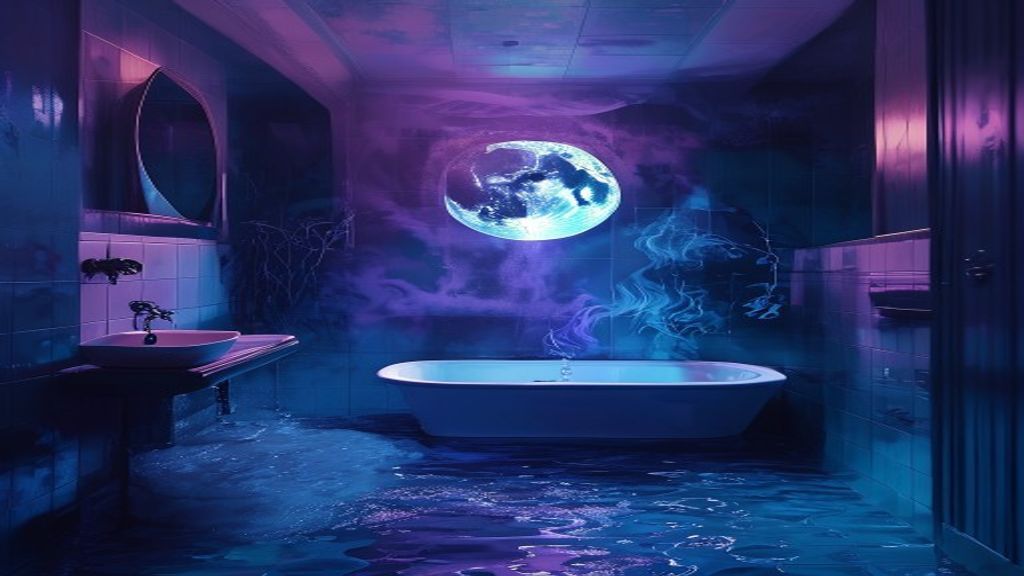
From the corridor you can see the water coming under the bathroom door, creeping across the tiles without a sound. You don’t move. Nothing about the image is dramatic, and yet it arrives fully formed, carrying its whole weight in one moment: something that was meant to stay contained isn’t contained any more.
The bathroom is the most private room in a house, and dreams know it. What happens in there isn’t for anyone else. When that space floods, something that was supposed to stay contained isn’t anymore. That’s the whole sentence.
A flooded bathroom in a dream usually signals that something emotional, usually something kept private, is exceeding its container. The water is almost always emotion in this context. Whether you tried to stop the flood or watched it happen shapes the meaning considerably.
The room that wasn’t meant to overflow
What makes the flooded bathroom different from, say, a flooded house is the specificity of the space. A flooded house is a big, general overwhelm. The bathroom is intimate and targeted. It’s where you’re alone. Where you’re unguarded. Where you deal with the body’s private business without an audience. Dreams don’t pick that room by accident when they want to show you something emotional spilling over.
In a dream’s architecture the bathroom sits among the functional rooms, the rooms of the body, the places the self goes but doesn’t linger. When the dream floods that room specifically, it’s suggesting that something you’ve been dealing with privately, something you thought was managed, is now too big for the space you’d assigned it. That’s not a catastrophe necessarily. Sometimes things outgrow their containers because they’ve grown, not because something went wrong.
The kind of water is worth noticing first. Clean overflow is different from dark or sewage water, because the quality of the element says something about the quality of the feeling. Clear water flooding a bathroom suggests a feeling that’s real and clean, just too large. Murky water points to something more complicated, something that’s been sitting too long or mixed with other things you’d rather not examine.
What you did when you found the water
The dreamer’s response inside the dream is often the most diagnostic thing about it. Not the flood itself but the reaction: did you run for towels, or freeze, or back out of the doorway and close the door? That response tends to mirror how you’re actually handling whatever emotion is flooding in your waking life.
The tap you didn’t turn off
There’s one specific image worth more time because it is so ordinary: the tap left running. Not dramatic flooding, not burst pipes. Just the ordinary tap, hot or cold, running unattended, and the basin spilling over quietly onto the floor. I call it the slow flood, and it’s a grief dream wearing workaday clothes. The emotional content isn’t urgent. It’s been going on for a while. The grief, the anxiety, the affection with nowhere to land, has been running steadily in the background of your life, and at some point the basin got full.
Domhoff’s continuity hypothesis would predict this: the dreams that track long-term emotional states tend to be quieter and more persistent than the dramatic ones. A burst pipe is a crisis. A running tap is a condition. The flooded bathroom from a running tap is the dream of the person who has been fine, technically, while also not quite being fine.
The question that unlocks this version isn’t what’s flooding. It’s what you’ve been leaving on.
The tower and the bridge
A short note on context. The flooded bathroom belongs with the compression dreams, the ones about spaces that are too small, or structures under pressure. A suspension bridge puts that pressure into architecture: a structure that holds, but effortfully, because of the weight it carries. If it shows up in the same weeks, the likely subject is a sustained period of strain in your waking life. An overflowing river is the outdoor version of the flooded bathroom, the banks failing to hold what the channel was built for.
This dream doesn’t require dramatic action to resolve. It is rarely a crisis dream. More often it belongs to someone who is simply carrying something they haven’t named or haven’t shared. Naming it, even just to yourself in the morning while the tiles are still vivid, sometimes does something. The tap doesn’t have to be on all the time. You’re allowed to turn it off, or at least lower it.
- What was the quality of the water? Clear and clean, or murky? That texture is the dream’s opinion of the emotion.
- What did you do when you found the flood? The action (or non-action) is the part most worth looking at.
- Is there something private, something you’ve been handling alone, that’s been running longer than it should?
- Did the flood feel like a crisis, or more like: oh, this has been happening for a while?
One symbol, two traditions
The two schools are not reading the same book: psychology asks what flooded bathroom is doing in your waking life, while the biblical tradition tests the image against Scripture and leaves the meaning with God.
A flooded bathroom in a dream usually signals that something emotional, usually something kept private, is exceeding its container. The water is almost always emotion in this context. Whether you tried to stop the flood or…
You are reading this oneScripture says nothing specifically about flooded bathrooms in dreams. It says a great deal about water as both threat and gift, about cleansing, about overflow, and about what happens when the things we contain privately exceed…
Read the biblical meaning →Quick answers
What does it mean to dream of a flooded bathroom?
It almost always means something emotional that was being kept private has exceeded its container. The bathroom is the most intimate room in dream-architecture, so its flooding points to something personal, not just generally stressful. The nature of the water and your response inside the dream are the most diagnostic details.
Does a flooded bathroom dream mean something bad is coming?
No. It points to a current emotional state, not a future event. Something is overflowing now, or has been for a while. That’s information you can act on, not a warning about what’s ahead.
What does the water quality mean in a flooded bathroom dream?
Clean, clear water suggests a feeling that’s real and straightforward, just too large for its current container, often grief, affection, or relief that hasn’t been expressed. Murky or dirty water points to something more complicated, possibly mixed with shame, old resentment, or things that have been sitting too long.
Why do I keep dreaming about bathrooms flooding?
Recurrence usually means the underlying private emotion hasn’t been acknowledged or expressed in waking life. The dream keeps returning because the tap is still running. Naming what you’ve been containing, or finding someone to share it with, tends to change the dream more than any other approach.
Sources for this reading
- Domhoff, G. W. (2003). The Scientific Study of Dreams: Neural Networks, Cognitive Development, and Content Analysis. American Psychological Association.
- Domhoff, G. W. (1996). Finding Meaning in Dreams: A Quantitative Approach. Plenum Press.
- Nielsen, T. A., Zadra, A. L., Simard, V., Saucier, S., Stenstrom, P., Smith, C., & Kuiken, D. (2003). The typical dreams of Canadian university students. Dreaming, 13(4), 211-235.DOI
Full bibliography on Sources and method. Found a mistake? Tell us and see the corrections log.