- Tradition
- Psychological readingNature dreams
- Also read in
- The BibleSame symbol, other tradition
- Draws on
- Domhoff, Artemidorus
- Reviewed
- 5 min read
G. William Domhoff’s continuity hypothesis holds that dreams extend waking concerns, and that matters for a dead tree, because the first instinct is almost always to read the symbol as an omen: loss or failure or death in the ominous sense. If dreams follow waking life, the tree is more likely pointing at something that has already ended in yours. And dead trees are complicated objects in the real world, which the dream seems to know. They outlast the living ones around them. They stand long after they’ve stopped growing. The roots are still there.
A dead tree in a dream points to something that has ended, stopped growing, or spent itself. Whether that reading is heavy or strangely peaceful depends entirely on what the tree was carrying: your own vitality, a relationship, a phase of life, or a version of yourself that’s been done for a while and just hasn’t been acknowledged yet.
What kind of ending are we talking about
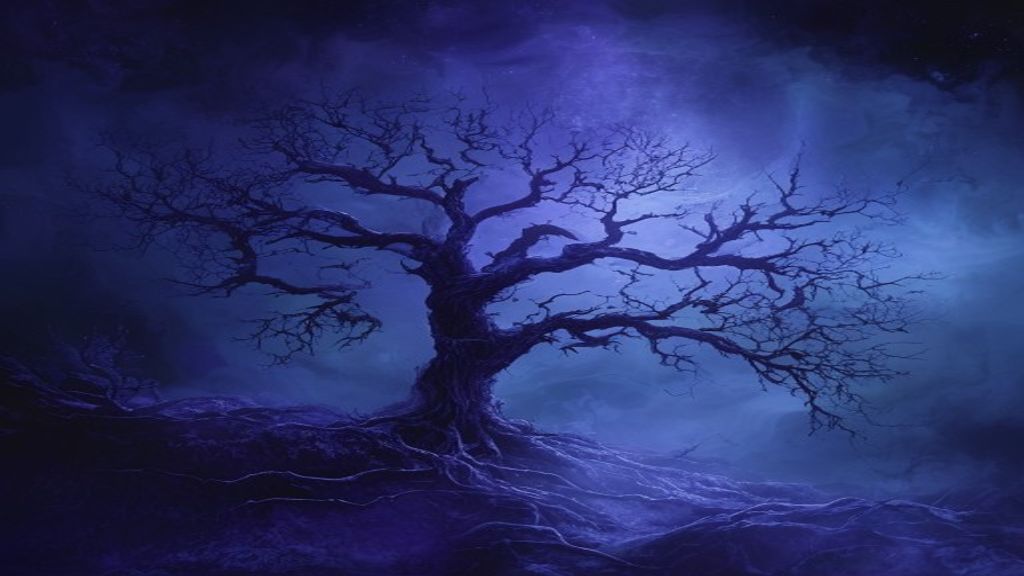
Dead isn’t one thing. A tree that was struck down at its peak, bark splintered, and a tree that slowly stopped leafing over the course of years are both dead, but they carry completely different feelings. The dream tends to encode this distinction in the tree’s appearance. A dead tree that is still standing, still dignified in its bare structure, usually points to something that ran its course. A fallen tree, roots upended, storm-damage everywhere, tends to point to something that ended suddenly, against its will or yours.
A Jungian reading takes the tree as an image of the self developing over time, the roots as origins, the trunk as accumulated life, the branches as the directions a person reaches toward. A dead tree in that framework is a self that’s stopped developing, or a part of the self that has. Not the whole person, usually. More like one branch of the life. The creative path that went quiet. The belief system that hollowed out. The relationship identity you used to carry and don’t anymore.
Reading the tree by what it still does
Here’s a more useful frame than just asking what died: what is the tree still doing in the dream? Because a dead tree is not nothing. It’s a structure. Birds use them. Light comes through them differently. They mark a place. How the tree functions in the dream often says more than the simple fact of its lifelessness.
The roots stay
The thing worth returning to is that dead trees in dreams almost always retain their roots. This is both botanically true and symbolically significant. Whatever has ended, the foundation it grew from is still there. The years you put in. The version of you that learned from it. The continuity hypothesis would simply say: if something has genuinely ended in your life, you’ll dream about the ended thing. Accurate. But what the theory doesn’t quite capture is the dream’s tendency to show you not just the death but the root system, as if it wants you to know what survives the ending.
Artemidorus, in his second-century dream manual, held that the same dream means different things for different dreamers, depending on age, status and occupation. He was writing for a world where a dead tree in your orchard was a real economic event. I take that as a useful historical baseline: the dream was never just aesthetic. It was always pointing at something that mattered practically, something that produced something in your life, and no longer does.
If the heaviness was in the whole landscape as much as in the tree, dreaming of black water is about a natural element that carries weight rather than beauty. And if the tree was struck down in a storm or by some sudden force, dreaming of a volcano asks what it means when change arrives violently rather than gradually.
There is a particular heaviness some of these dreams carry: something has been dead for a long time and has been left standing because removing it would remove something else. Cutting down such a tree can feel more final than the ending itself, as if it had been the last thing holding the shape of a place. The tree is the root system of everything remembered about an earlier time, and when it goes, the roots seem to go too. If your dead tree dream carries that heaviness, you already understand the reading better than I can give it to you.
For the counterpart to this symbol, the tree in full bloom and what it means when growth announces itself, see dreaming of a flowering tree.
- Was the tree standing or fallen? That distinction usually says something about how the ending happened.
- Did the tree still have its roots visible, or was it more like a stump, presence without depth?
- What did the tree feel like it had been carrying? Whose life, which part of yours?
- Is there something in your waking life that you’ve known was over but haven’t fully let yourself acknowledge?
One symbol, two traditions
The disagreement is honest: one school sees dead tree as self-communication, the other as an image to be discerned against Scripture. They can inform each other, but they do not merge.
A dead tree in a dream points to something that has ended, stopped growing, or spent itself. Whether that reading is heavy or strangely peaceful depends entirely on what the tree was carrying: your own vitality, a relationship, a…
You are reading this oneWithering in Scripture consistently relates to wrong rootedness or the absence of what produces life. Psalm 1 uses the non-withering leaf as the mark of a life drawing from the right source. Jeremiah 17 contrasts the desert shrub…
Read the biblical meaning →Quick answers
What does dreaming of a dead tree mean?
It points to something in your life that has ended, stopped growing, or run out of life. This might be a relationship, a creative pursuit, a belief, a version of yourself, or a life phase. The tree’s appearance (standing or fallen, with roots visible or not) gives you the emotional texture of the ending.
Is dreaming of a dead tree a bad omen?
Not straightforwardly. A dead tree is a symbol of ending, not of failure. Some endings are appropriate, even necessary. The dream is more interested in whether you’ve acknowledged the ending than in judging it. Dread or avoidance in the dream usually says more than the dead tree itself does.
What does it mean if a dead tree is standing in my dream?
A standing dead tree typically signals something that ran its course rather than something that was cut down. The structure remains even though the life has left it. This often shows up when you’re in the quiet aftermath of an ending, past the acute stage and into the process of integrating what’s gone.
Why do I keep dreaming about a dead tree?
Recurring dead trees usually mean there’s an ending in your waking life that hasn’t been fully acknowledged. The dream stops repeating when you name what’s over, grieve it properly, or make a deliberate decision about what to do with the roots it left behind.
Sources for this reading
- Domhoff, G. W. (2003). The Scientific Study of Dreams: Neural Networks, Cognitive Development, and Content Analysis. American Psychological Association.
- Domhoff, G. W. (1996). Finding Meaning in Dreams: A Quantitative Approach. Plenum Press.
- Artemidorus of Daldis (2nd century CE). Oneirocritica. English edition: Harris-McCoy, D. E. (2012). Artemidorus’ Oneirocritica: Text, Translation, and Commentary. Oxford University Press.
Full bibliography on Sources and method. Found a mistake? Tell us and see the corrections log.