- Tradition
- Psychological readingObject dreams
- Draws on
- Domhoff, Hobson, Artemidorus
- Reviewed
- 5 min read
The door of the room works perfectly well, and that is the strange part. The handle is cool and a little dusty under your fingers, and you let go of it again. Nothing is holding you in. The air is simply still, the way it is on a Sunday afternoon when you have nowhere to be and somehow the walls have moved closer. Cages in dreams don’t always have bars. Sometimes it’s a room that’s locked, a car that won’t move, a space that’s technically fine and completely airless. The form changes. The feeling doesn’t.
You’re not trapped by anything real. You’re trapped by the space between what your life is and what you thought it would be by now. The cage in those dreams isn’t built from metal. It’s built from distance.
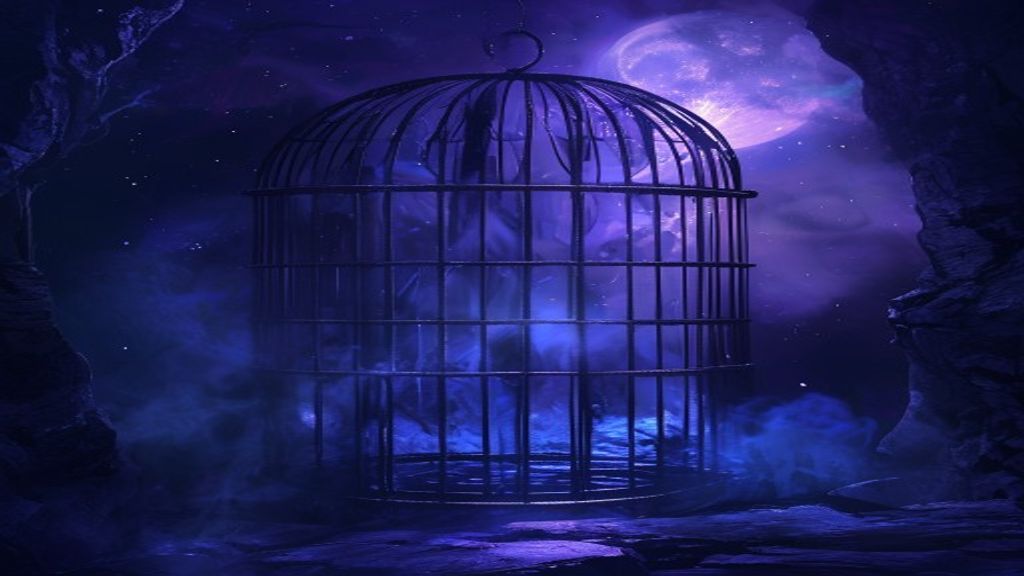
A cage in a dream most often represents a felt constraint in waking life: a relationship, a job, a belief about yourself, or an obligation that’s closed the available space. Where you are in relation to the cage, inside, outside, or building it, is the single most important detail.
Three positions, three readings
- You’re inside and can’t get outThis is the most straightforward version, and often the most urgent. Something in your waking life has eliminated meaningful options. Your mind is being honest about the walls. The question to ask is whether the cage is external, a situation truly locking you in, or internal, a fear, a belief, a learned smallness that you’ve been mistaking for walls.
- You’re outside, watching something cagedThe caged figure is the part of you that isn’t getting space or expression. If it’s an animal, ask what that animal’s qualities feel like: wild, powerful, instinctive, something you’ve penned in for safety’s sake. If it’s a person, it’s likely an aspect of your personality or an older self that didn’t make it through some previous change intact.
- You built the cage, or you’re holding the keyThe hardest version to sit with. It means your mind is clear about the source of the constraint, even if you’re not. You put yourself in this. That’s not blame. It’s information. The cage might have been necessary once. The question the dream is asking is whether it still is.
What the bars are made of
The material of the cage almost never matters to the reading, but the condition of the lock does. An unlocked cage you’re staying inside anyway is its own particular sentence. Your mind knows the door is open. The dream is watching you not use it.
The cage dream is a constraint dream, and constraint dreams cluster around exactly the kind of waking pressures Domhoff’s continuity hypothesis predicts. Job transitions, failing relationships, long-standing obligations, situations where the options genuinely narrowed or where you began to realize the narrowing wasn’t coming from outside. His DreamBank data would place this in a predictable pattern. There’s something almost comforting about that, if you can hold it sideways.
Hobson, who spent his career skeptical of symbolic dream reading and interested in the neuroscience, would probably say the cage is a fairly direct representation of sensory or physical constraint, your sleeping body processed as a spatial metaphor. He might be right. I think both readings can coexist: the brain produces the metaphor, and the metaphor is still accurate.
The open door you’re not walking through
This is the version most worth lingering on, because it’s the most uncomfortable one. You’re in a cage in your dream. The door is ajar, or the lock is broken, or no one is watching. And you stay.
It’s not stupidity. It’s not passivity, exactly. It’s that the cage has become, at some point, a known quantity. The outside is unfamiliar. The cage is at least a space you understand. The dream isn’t judging you for that. It’s just noting, with some precision, that the door is open and you know it.
Older readings took cages and enclosures as omens of entrapment, restriction, sometimes impending imprisonment, external threat portents. Artemidorus’s principle from the second century, that the same dream means different things for different dreamers, already loosens that. The psychological reading turns it inside out: the portent isn’t about what’s coming from outside. It’s about what you’ve already built from within.
The cage dream sometimes travels with dreaming of handcuffs, which has a sharper edge around restriction imposed by someone else rather than structure you’ve internalized. And if the walls themselves felt like they might not hold, dreaming of a bomb is about pressure building inside a closed space.
If the cage keeps appearing
Recurring cage dreams are almost always tracking a constraint that hasn’t been named out loud yet. Your mind is being patient with you. It’ll keep building the set and putting you in it until you’ve either changed the situation or at least acknowledged, clearly, what’s actually restricting you.
The Sunday-afternoon feeling from the start can last for years, and the cage can come with it. Not always bars. Sometimes just a room where the door works fine and you stand near it for the entire dream, not touching it. The dream is accurate. You know it’s accurate even in the dream. You still don’t open the door. That’s worth something, actually. Not as a diagnosis. As evidence of how honest your sleeping mind is willing to be, when you’re not around to argue.
- Was I inside, outside, or holding the key, and what does my position tell me about where the constraint is coming from?
- If the door was open or unlocked, what was I weighing against walking through it?
- Which area of my waking life feels like it’s run out of room lately?
- Is the cage protecting me from something, and is that protection still necessary?
Quick answers
What does it mean to dream of a cage?
A cage in a dream almost always represents felt constraint, a situation, relationship, obligation, or belief that has closed down your options. The most diagnostic detail is your position: inside it, outside watching something caged, or in possession of the key.
Does dreaming of a cage mean I feel trapped?
Often, yes, but not always in the way you’d expect. Sometimes the cage is a known space you’ve stayed in even with an open door, which means the constraint is partly self-imposed. The dream tends to be quite clear about that distinction if you pay close attention to the lock.
What does it mean to dream of an animal in a cage?
The animal usually represents a quality you’ve suppressed or penned in: instinct, aggression, creativity, freedom, depending on the animal. It’s less about the animal and more about which of its characteristics you haven’t been giving space in your waking life.
Why do I keep dreaming about being in a cage?
Recurring cage dreams tend to follow ongoing constraints that haven’t been acknowledged, addressed, or accepted. The dream keeps building the same structure because the underlying situation hasn’t changed. Naming what the cage actually stands for in waking life is usually what retires it.
Sources for this reading
- Domhoff, G. W. (2003). The Scientific Study of Dreams: Neural Networks, Cognitive Development, and Content Analysis. American Psychological Association.
- Domhoff, G. W. (1996). Finding Meaning in Dreams: A Quantitative Approach. Plenum Press.
- Hobson, J. A., & McCarley, R. W. (1977). The brain as a dream state generator: An activation-synthesis hypothesis of the dream process. American Journal of Psychiatry, 134(12), 1335-1348.DOI
- Artemidorus of Daldis (2nd century CE). Oneirocritica. English edition: Harris-McCoy, D. E. (2012). Artemidorus’ Oneirocritica: Text, Translation, and Commentary. Oxford University Press.
Full bibliography on Sources and method. Found a mistake? Tell us and see the corrections log.